
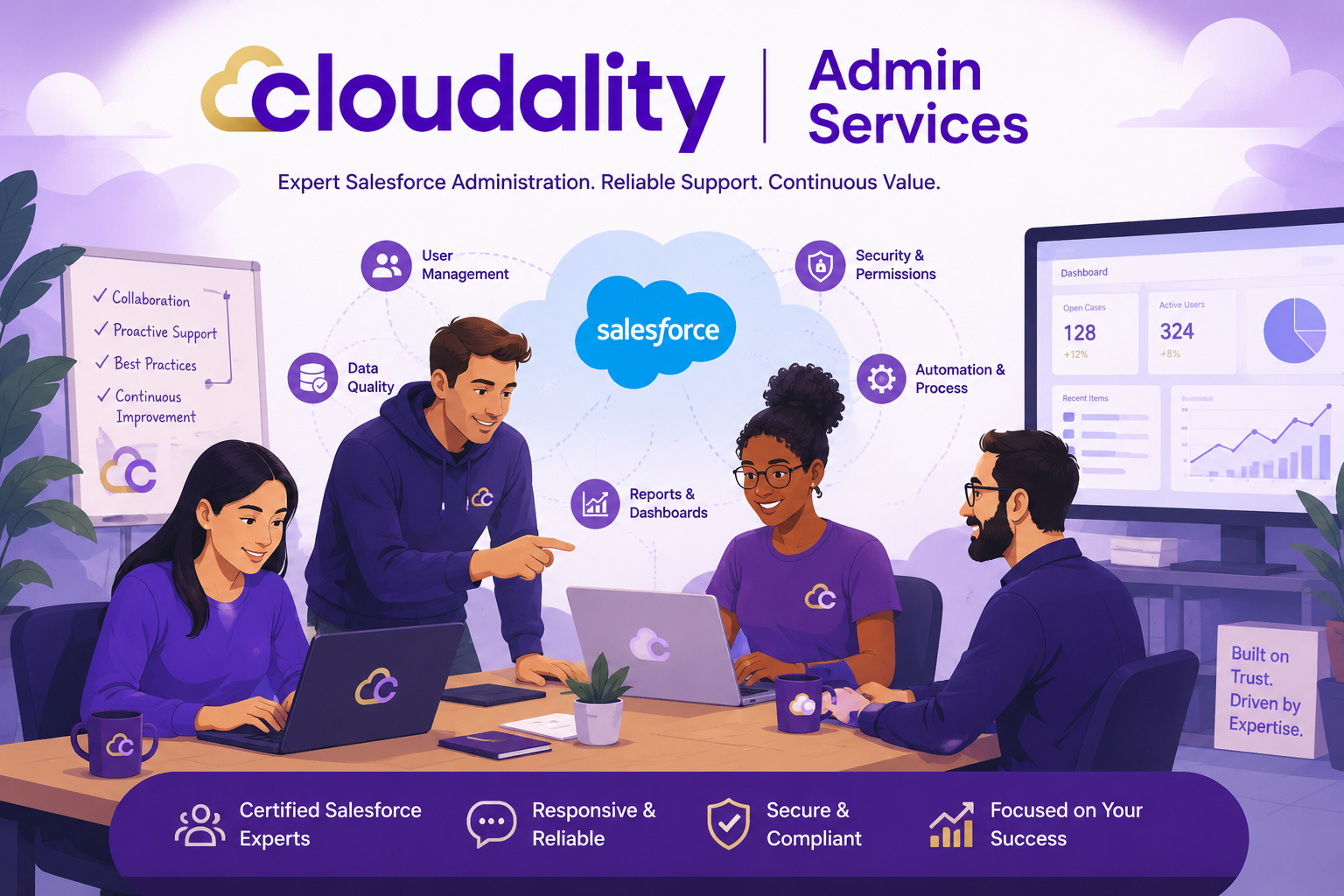
Every Salesforce admin has a list. You know the one: the messy permission model you inherited, the SPIFF spreadsheet finance emails out once a month, the Workflow Rules that still need to move to Flow before Salesforce sunsets them for good. The list doesn't get shorter on its own, and most admins don't have the bandwidth (or the budget sign-off) to tackle it as one giant initiative.
That's the gap Cloudality's Admin Services are built to close.
Instead of an open-ended consulting engagement, Admin Services works in short, defined bursts:
There's no lengthy discovery phase and no estimate cycle. You know the cost and the outcome before anything starts.
If you're not sure where your org needs the most help, the Org Health Assessment is the lowest-commitment entry point: a short audit that produces a written findings report pointing to everywhere else worth looking at.
Across dozens of engagements, four quick starts come up again and again:
SPIFF / Incentive Tracker: If your sales incentives still live in a spreadsheet that finance updates monthly, your reps have no idea where they stand until payday. This three-week build replaces that with a custom SPIFF object, a rep submission flow validated against the deal record, a two-step approval path for sales management and finance, and a dashboard reps can check anytime: eligible, submitted, approved, paid. It's scoped small enough for a sales leader to sponsor directly, and the daily-use visibility tends to drive adoption fast. (Payroll integration, historical backfill, and multi-currency logic are available later as their own follow-on projects.)
Flow Migration: Salesforce is retiring Workflow Rules and Process Builder. That's a deadline on your org whether or not it's on your roadmap. This engagement converts legacy automation to Flow on a fixed timeline, delivered by the same team that will to support the org afterward.
Permission Set Overhaul: Profile-based access is one of the most common findings in a Salesforce security review, and one of the messiest things to untangle once you're already mid-audit. This quick start moves you to permission-set-based access with sharing rules and field-level security reviewed proactively, before an auditor flags it for you.
Org Health Assessment: The starting point for admins who know something's off but aren't sure what. A short audit, a written report, and a clear recommendation for what to do next.
Every Admin Services project, regardless of which one you pick, follows the same five-step process:
Predictable dates, agreed in writing, before a single hour of work starts.
SPIFF trackers, Flow migrations, and permission overhauls are just the entry points people ask about most. The full catalog runs to 18 fixed-scope engagements across seven categories:
Every item on that list is priced from the same published rate card and scoped to close in two to four weeks.
The logic behind Admin Services isn't just about speed - it's a deliberate way to de-risk working with a new team. Organizations that start with a single fixed-scope engagement get a firsthand look at how Cloudality scopes, communicates, and delivers before ever considering a larger, ongoing program. Many go on to see meaningful platform cost reductions, faster automation delivery, and clearer executive visibility into ROI, but that usually starts with one small project, not a big commitment upfront.
Two ways to get moving:
Either way, you leave with something working, documented, and handed off - not just a plan for later.
Clean Salesforce foundations just became more valuable, not less.
Every Salesforce admin has a list. You know the one: the messy permission model you inherited, the SPIFF spreadsheet finance emails out once a month, the Workflow Rules that still need to move to Flow before Salesforce sunsets them for good.
WRITE ABOUT AI, but DO NOT WRITE WITH AI.
WRITE ABOUT AI, but DO NOT WRITE WITH AI.